Free Shipping on Orders Over $200

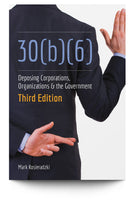
30(b)(6): Deposing Corporations, Organizations & the Government, Third Edition

Mark R. Kosieradzki
$195.00

Format
Condition

Pre-order now to make sure you don't miss out!

This title is scheduled to begin shipping by 2/24/26

Description

How do you depose something that isn’t a person? In 30(b)(6): Deposing Corporations, Organizations, and the Government, author Mark Kosieradzki answers that question and gives you the tools you need to cut through defense smokescreens and end the runaround once and for all.

Kosieradzki breaks down Federal Rule of Civil Procedure 30(b)(6) and shows how to navigate the bureaucratic maze and build a substantial record of the defense’s words and documents to hold them accountable. Kosieradzki offers advice on communicating with cagey representatives, dealing with the defense’s obstacles, and performing effective and efficient 30(b)(6) depositions in all fifty states.

Kosieradzki addresses the 2020 amendment to Rule 30(b)(6) that establishes the need to “meet and confer,” discusses the jurisprudence concerning post COVID-19 pandemic logistics, provides updates on how each state–from California to Washington and Florida to New York–have amended their own rules or added different provisions. And just as important, he teaches how to counter the many new ways defense lawyers have invented to try and evade and obstruct your ability to get to the truth.

The new third edition of Kosieradzki’s 30(b)(6): Deposing Corporations, Organizations & the Government builds upon the analysis, strategy, and case law in the first two editions and addresses the most important issue since the 2020 amendment change: trial.

Featuring a complete rewrite of the section on using 30(b)(6) testimony in trial, and including new updates on how Federal Rule of Civil Procedure 30(b)(6) has been adopted in all fifty states, this edition gives lawyers involved in litigation with institutional parties the tools they need to navigate their cases from deposition to verdict. Although the principles of the 30(b)(6) discovery process have remained stable, the entire body of law involving the use of 30(b)(6) at trial has seen significant updates. With this new edition, you will be armed with the law you need as you head to trial.

After all, great cases need great evidence. In 30(b)(6), Mark Kosieradzki shows you how to get the evidence you need.

Author

Details

Hardcover: 592 pages; 3rd edition (2025); ISBN: 9781951962098

Publisher: Trial Guides, LLC

Table of Contents

Preface to the Third Edition

Preface to the Second Edition

Acknowledgments

Foreword to the Third Edition by Sach Oliver

Foreword to the Second Edition by John Romano

Publisher’s Note

Introduction

  1. Deposing Organizations
    1. Introduction
    2. Learning about 30(b)(6)
    3. Deposing Organizations in State Courts
    4. The Steps of Rule 30(b)(6)
    5. Summary
  2. Building a Record
    1. Introduction
    2. Set Up the Legal Framework
    3. Lock Down Facts
    4. Establish Standards of Conduct
    5. Establish Motive
    6. Neutralize Defenses
    7. Summary 
  3. Details of Rule 30(b)(6): Deposing Organizations by Issue Designation
    1. Introduction
    2. Rule 30(b)(6) by Issue Designation
    3. Depose Nonparties with Rule 30(b)(6)
    4. Subpoenas Are Issued by the Presiding Court
    5. Location of a Nonparty 30(b)(6) Deposition
    6. Objections to Nonparty Subpoenas 
    7. You Can Depose Noncorporate Organizations with 30(b)(6)
    8. Depose Government Entities with 30(b)(6)
    9. Depose Foreign Organizations with 30(b)(6)
    10. Summary
  4. Rule 30(b)(6) Logistics: Location, Duration, and Number of Depositions
    1. Introduction
    2. You Choose the Sequence of Discovery and Depositions
    3. Location of a Party Deposition
    4. Location of a Nonparty Deposition 
    5. Calculation of Time Limitations
    6. Multiple Witnesses for a Single 30(b)(6) Notice
    7. Multiple 30(b)(6) Notices
    8. Designee v. Individual Depositions
    9. Video Depositions
    10. Virtual Depositions
    11. Summary
  5. Deposing Officers, Directors, and Managing Agents: 30(b)(1) Depositions
    1. Introduction
    2. A Managing Agent’s Word Binds an Organization
    3. Where Do Depositions Take Place?
    4. Is Your Witness a Managing Agent? 
    5. Former Officers, Directors, and Managing Agents
    6. Deposing Executives
    7. Who Establishes That This Deposition Is Necessary?
    8. Rule 30(b)(6): An Alternative to Deposing the Executive
    9. Summary
  6. Deposing Low-Level Employees
    1. Introduction
    2. Informal Communication Employees
    3. Former Employees
    4. Responsibilities During the Investigation
    5. Involuntary Representation
    6. Summary
  7. Crafting the 30(b)(6) Notice: The Requesting Party’s Duties
    1. Introduction
    2. Reasonable Particularity and Painstaking Specificity
    3. Qualifiers
    4. You Decide the Method of Discovery
    5. Summary
  8. Scope of the 30(b)(6) Notice: What Can You Ask About?
    1. Introduction
    2. Scope of Discovery
    3. What Can You Ask in Matters of Examination?
    4. Summary
  9. Rule 30(b)(6) Foundation Depositions
    1. Introduction
    2. Problems with Rule 34 Document Requests
    3. Objections to Rule 34 Document Requests
    4. What Is “Possession, Custody, and Control?”
    5. Produced Documents Must Be Organized
    6. The Solution: Rule 26(b)(1) Foundation 30(b)(6) Deposition
    7. Rule 30(b)(6)
    8. Foundation for Future Requests
    9. Preempt Improper Objections
    10. Summary
  10. Electronic Discovery
    1. Introduction
    2. Technological Framework
    3. Understanding the Interplay of Discovery Rules for Tailoring Requests
    4. 30(b)(6) Foundational Depositions on ESI Systems
    5. Overcoming Objections to Rule 30(b)(6) ESI Foundation Depositions
    6. Overburdensome by Design
    7. Internal Database Report Capabilities
    8. Email 30(b)(6) Testimony
    9. Summary
  11. Process-Based Discovery: Identifying Incomplete Discovery Using 30(b)(6)
    1. Introduction
    2. Process-Based Discovery, a.k.a. “Discovery about Discovery”
    3. When Is Process-Based Discovery Appropriate?
    4. Summary
  12. Duty to Attend
    1. Introduction
    2. Duty to Appear
    3. Summary
  13. Duty to Prepare
    1. Introduction
    2. Duty to Designate
    3. Duty to Prepare
    4. Privilege Waiver
    5. Duty to Substitute a New Witness
    6. Summary
  14. Scope of Inquiry
    1. Introduction
    2. Limiting the Scope Is Not Allowed
    3. Scope of Inquiry Objections
    4. Instructions Not to Answer
    5. Summary
  15. Deposition Obstruction
    1. Introduction
    2. Obstructive Deposition Tactics Are Prohibited
    3. Conferring with Witnesses during Depositions
    4. Objections
    5. Sanctions
    6. Conclusion
    7. Summary
  16. Motions to Compel and Sanctions
    1. Introduction
    2. Motion to Compel Facts
    3. Motion to Exclude Different Testimony
    4. Failure to Provide a Witness
    5. Delay Tactics
    6. Appearance with Inadequate or Unprepared Testimony
    7. Duty to Confer
    8. Expenses for Compelled Depositions
    9. Failure to Comply with an Order for Disclosure: Subsequent Sanctions
    10. Summary
  17. Binding Effect
    1. Introduction
    2. The Witness Does Not Have Information
    3. Summary
  18. Changing the Testimony
    1. Introduction
    2. Sham Affidavit Rule
    3. Deposition Errata Sheet Changes 
    4. Three Schools of Permissible Change
    5. Inquiring into the Basis for the Errata Sheet Change
    6. Summary
  19. Using 30(b)(6) Testimony at Trial
    1. Introduction
    2. Using a Party 30(b)(6) Deposition at Trial
    3. Using Nonparty 30(b)(6) Witness Depositions at Trial
    4. Using 30(b)(6) Depositions from Other Cases
    5. Can Live Testimony from the 30(b)(6) Witness be Compelled for Trial?
    6. Attempts to Change the Story at Trial
    7. Motions in Limine
    8. Summary

Epilogue

Appendix A: Rule 30(b)(6) in All Fifty States

Appendix B: Sample 30(b)(6) Notice

Appendix C: Foundation Deposition Notice

Appendix D: Rule 30(b)(6) Depositions for Email

Appendix E: Contention 30(b)(6) Deposition

Appendix F: Corporate Structure 30(b)(6) Deposition

Appendix G: 30(b)(6) Federal Rule Change History

Index

About the Author

Related Information

Free Chapter Sample

What Legal Leaders Are Saying

Corporations, institutions, and our governments enjoy the benefit of being recognized as people and get to be treated as such under the law. Jurors are instructed to treat them the same way they would treat individual human beings. Knowing 30(b)(6) inside and out is essential to discovering evidence and preparing for trial. It is through this vehicle that we are able to take depositions and obtain evidence and testimony from the organization for use at trial. I cannot count the number of times I got lost trying to navigate 30(b)(6). Mark Kosieradzki’s book was the guide I needed. Mark’s work has been a huge help to so many and now he graciously takes it to the next level for us all. Unsurprisingly, the enemy has worked over the years to muddy the waters and cause confusion and get shelter from Mark's storm. This third edition makes things clear and blows the roof off of obstruction and bait and switch tactics, allowing us to discover and expose the truth so that we can hold badly behaved organizations accountable through discovery and trial. This wonderful book is an absolute must for all lawyers who prosecute civil cases. Thank you again Mark for your contribution to civil justice and helping make us all better at what we do.

— Nick Rowley, coauthor of Trial by Human and Running with the Bulls

I have been utterly confounded by the reality that there is no procedural mechanism for calling a corporate party to the witness stand at trial since Rule 30(b)(6) can only be used to acquire deposition testimony. For years, Mark Kosieradzki has been teaching us all how to get the 30(b)(6) testimony that our clients need to prove their cases. With this new book, Mark has come out of retirement to teach us all how to get that 30(b)(6) testimony into evidence at trial. Koz is the giver that keeps on giving!

— Render Freeman, faculty member for the American Association for Justice and graduate of the Spence Trial Lawyer’s College

Mark Kosieradzki does it again! In this powerful new chapter of his landmark treatise, 30(b)(6):Deposing Corporations, Organizations & the Government, Kosieradzki distills the most complex corner of civil litigation—Rule 30(b)(6) trial use—into clear strategy. With precision and real-world insight, he shows how to turn a corporation’s sworn testimony into binding admissions the jury must hear, how to shut down last-minute story changes, and how to stop experts and witnesses from rewriting corporate truth. Another masterful contribution from the nation’s foremost authority on 30(b)(6) practice.

— Lesley Ann Clement, chair AAJ, Nursing Home Litigation Group (2024-2025)

Mark single handedly improved plaintiff’s trial practice with his groundbreaking yet approachable books on deposing 30(b)6 witnesses and overcoming deposition obstruction. His work made us so much more effective, the defense invented new ways to try to block our use of 30(b)6 evidence at trial. This new edition gives the legal basis and practical advice on how to combat these new tactics. This is a must read for every trial lawyer. Mark has done the thinking and the research for us.

— Joe Fried, founder of the Academy of Truck Accident Attorneys and trial lawyer with $1 billion in recoveries

The leading legal expert in the nation on Rule 30(b)(6) depositions, Mark Kosieradzki, strikes gold again in this third edition of 30(b)(6):Deposing Corporations, Organizations & the Government. Any lawyer who litigates cases where a 30(b)(6) deposition is likely to be taken needs this encyclopedic bible to navigate the unique rules that apply to these critical depositions. It is jam packed with case citations, examples, and insightful practice pointers. A bonus appendix of state equivalents is included. It is truly worth its weight in gold.

— Hon. Mark W. Bennett (ret. US district judge), director emeritus of the Institute for Justice Reform & Innovation at Drake University Law School

Ten years ago, Mark Kosieradzki wrote what has become a fundamental source for a key deposition strategy for plaintiffs. Most of us depend on 30(b)(6) depositions to prove fundamental elements of our case, reduce dependence on experts, and establish the principles jurors will rely on to hold defendants responsible. Things change, what you have done successfully in the past may not work in the future. Defendants and the defense bar have been threatened by the success of lawyers using 30(b)(6) who have been able to turn ordinary cases into cases with substantial verdicts. It’s in the opposition’s interest to complicate, obfuscate, and eliminate (whenever possible) the substantive, effective use of the 30(b)(6) deposition. This third edition specifically deals with the most recent attempts to bar and/or interfere with 30(b)(6) testimony by raising objections to its admissibility based on FRE 602 (personal knowledge) and FRE 802 (hearsay), make the use of the deposition testimony cumbersome by arguing for lengthy counter designations based on the rule of completeness under FRCP 32(a)(6) and FRE 106. Mark provides a clear, step-by-step process to bullet proof your 30(b)(6) and its admissibility both before and after the deposition has been taken, and provides a trove of reported cases you’ll need to use when you have this kind of fight. This is a must have for any trial lawyers’ library—and the update in the third edition should not be missed.

— Phillip Miller, author of Advanced Depositions Strategy and Practice

We’ve lately been hit with an increasing barrage of defense tactics that have managed to keep our 30(b)(6) evidence out of trial. It’s Kosieradzki’s fault. His first two editions so well blocked defense 30(b)(6) discovery obstructions that the defense had to redesign their 30(b)(6) machinations to stop evidence in trial that they found inconvenient. But just as no one ever expects the Spanish Inquisition, the defense never expected this third edition, as effective in trial as Mark’s first two editions were in discovery. 孙子 (Sun Tzu) says to shut every enemy s escape hole. In trial, this edition slams shut the 30(b)(6) escape holes. No surprise. Mark’s wisdom has long provided gold-standard guidance. This edition—which is its topic’s gold standard—does that tradition proud.

— David Ball, author of David Ball on Damages

The forces of darkness never stop trying to obscure, evade, and dodge the search for truth in civil discovery. In the first two editions of his landmark book on corporate depositions, Mark Kosieradzki gave us the weapons to use Rule 30(b)(6) to maximum effectiveness against these dark art weaselers. Now in this third edition, Mark confronts and slays a whole new set of tricky tactics. Just when the plaintiff lawyer stands up to present the hard-won kernels of truth from the corporate spokesperson’s transcript, the adversary cries, “Hearsay, your honor! And lack of personal knowledge!” And of course, they show up at trial with a new spokesperson with a different story and experts singing from the new and improved songbook. But can they do that? As Koz teaches us in these pages: No, they cannot. But you’ve got to be prepared for the new tricks. Koz patiently walks through how seemingly contradictory rules actually harmonize nicely with each other, what the courts say, and what we advocates need to be ready for. It’s all essential stuff, and well written and comprehensive to boot. Take that, bad guys!

— Patrick Malone, member of Inner Circle of Advocates, coauthor of Rules of the Road and author of The Fearless Cross-Examiner
30(b)(6): Deposing Corporations, Organizations & the Government, Third Edition - Trial Guides
Trial Guides

30(b)(6): Deposing Corporations, Organizations & the Government, Third Edition

$195.00

How do you depose something that isn’t a person? In 30(b)(6): Deposing Corporations, Organizations, and the Government, author Mark Kosieradzki answers that question and gives you the tools you need to cut through defense smokescreens and end the runaround once and for all.

Kosieradzki breaks down Federal Rule of Civil Procedure 30(b)(6) and shows how to navigate the bureaucratic maze and build a substantial record of the defense’s words and documents to hold them accountable. Kosieradzki offers advice on communicating with cagey representatives, dealing with the defense’s obstacles, and performing effective and efficient 30(b)(6) depositions in all fifty states.

Kosieradzki addresses the 2020 amendment to Rule 30(b)(6) that establishes the need to “meet and confer,” discusses the jurisprudence concerning post COVID-19 pandemic logistics, provides updates on how each state–from California to Washington and Florida to New York–have amended their own rules or added different provisions. And just as important, he teaches how to counter the many new ways defense lawyers have invented to try and evade and obstruct your ability to get to the truth.

The new third edition of Kosieradzki’s 30(b)(6): Deposing Corporations, Organizations & the Government builds upon the analysis, strategy, and case law in the first two editions and addresses the most important issue since the 2020 amendment change: trial.

Featuring a complete rewrite of the section on using 30(b)(6) testimony in trial, and including new updates on how Federal Rule of Civil Procedure 30(b)(6) has been adopted in all fifty states, this edition gives lawyers involved in litigation with institutional parties the tools they need to navigate their cases from deposition to verdict. Although the principles of the 30(b)(6) discovery process have remained stable, the entire body of law involving the use of 30(b)(6) at trial has seen significant updates. With this new edition, you will be armed with the law you need as you head to trial.

After all, great cases need great evidence. In 30(b)(6), Mark Kosieradzki shows you how to get the evidence you need.

Format

  • Hardcover

Condition

  • New
View product
