

Great Book!
"Very helpful and practical guidance."
Free Shipping on Orders Over $200

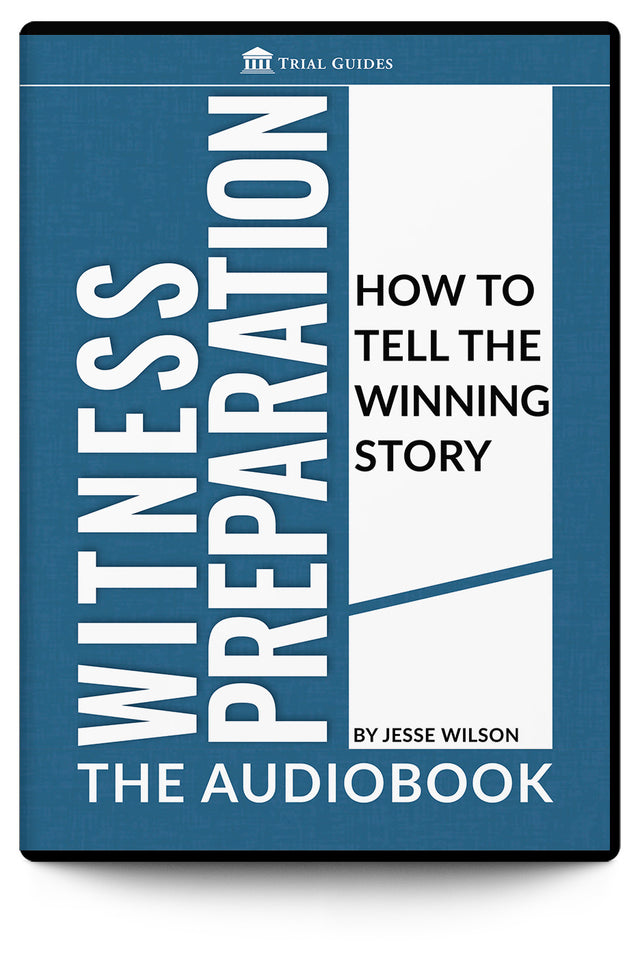
Witness Preparation: How To Tell The Winning Story (Audiobook)
“If you want ordinary results, don’t read this book. If you want to learn how to cast your client such that their compelling voice and spirit shines through, [so] that others root for them, protect them, and even fight for them, read this book now. This book will shift your thoughts about what the most compelling damages story is, and it gives you practical pointers to put these new ideas in action right away in your cases—for trial and even for pretrial settlement.”
—Joe Fried, co-founder of the Academy of Truck Accident Attorneys and trial attorney with $1 billion in recoveries
How do you see your witness? How will the jury see them? The judge? The defense? The more compelling—the more credible—your witnesses are, the more you increase your chances of obtaining a just outcome for your client.
In Witness Preparation: How to Tell the Winning Story, trial consultant and strategist Jesse Wilson teaches you how to prepare your clients, experts, and lay witnesses to deliver effective testimony during both deposition and trial. Wilson has spent years helping trial lawyers and their clients discover, develop, and deliver winning testimony in trial—often resulting in multimillion-dollar verdicts.
Wilson draws from his experiences working alongside trial teams in wrongful death cases, trucking cases, criminal cases, civil cases, and numerous brain injury cases to provide checklists, actionable steps you can immediately take, insightful case studies, trial transcripts, and more, to help you bring out the best testimony from your witnesses. He also introduces you to witness-preparation and case-framing tips from the trial lawyers across the country that he has worked with over the years.
Wilson shows you how to work with your witnesses to present the right story in trial and deposition, one that inspires jurors to action through effective testimony that helps them understand the harms your client has suffered. Throughout the book, Wilson uses what he refers to as the “victim to victor” approach to empower your clients, improve your damages arguments, and present the truth of the consequences your clients are living with—and fighting to overcome—to galvanize jurors to action.
Wilson explains that clients are often mischaracterized when they are solely framed in terms of what was taken from them. When your trial story only focuses on the pain, you risk diminishing your client or making jurors feel manipulated. But a trial story that is framed around joy in the defiance of pain—and the strength it takes to strive to overcome the harm the defendant caused—empowers jurors to act. Referencing the work of Moe Levine, Wilson quotes that “it’s not what they took, it’s what they left behind.” The victim-to-victor approach focuses on showing that what they left behind is the strength of overcoming what has been taken. When it comes to the witness, this should be the lawyer’s primary focus.
Wilson argues (and has the record to prove it) that jurors care more when they see fighters up there on the stand. Somebody they can get behind and help, long after the trial is over. When lawyers go with the tactic of “the poor client, their life is ruined, give them money” jurors end up feeling manipulated. Wilson shows that you shouldn’t care about that story. If you show the fight in your clients, their fight becomes the jurors’ fight.
Wilson teaches how you can develop and deliver a great story of systematic, willful misconduct, a story of serious life-altering injuries, and a story of hope, redemption, and joy. And in the courtroom, Wilson points out that joy is impossible to defend against. As he puts it, “Imagine the defense attorney saying to the judge, ‘Your honor! Mr. Smith is inspiring the jurors too much!’ Or better yet, ‘Your honor! Mr. Smith is allowing his client to inspire the jurors too much!’ That would be a gift, wouldn’t it?”
In this book, you’ll learn a new focus and new action pattern; you’ll be able to frame your case and present your client’s story (and your villain’s story as you’ll learn about in the chapter on preparing for adverse witnesses) in the right way.
Wilson also demonstrates how the victor story can be used to show the defense for who they most often are: the person (or company) who knows the most and cares the least. He provides tools to show the jury how the person (or company) who had the most power to prevent the harm from happening didn’t care in the least that it actually happened.
Later in the book, Wilson also discusses how you can guide your expert witness to give their testimony in the form of a story that the listener feels connected to. Your expert needs to draw the listener into that story. Wilson shows you how you can act as a director and help your expert craft a presentation in a way that engages your judge and jurors so that the information the expert gives them will be embraced and internalized.
Most witnesses are rarely certain of who they need to be, for depositions, for pretrial, and for trial. Learn to reveal them as what they really are, and need to be, for the jury: the victor. In this book, you will learn to apply the victim-to-victor approach to framing and presenting the right story to your jurors, as you prepare both your client (and yourself) for trial. The lessons and methods in this book that Wilson offers will grant you transformative tools that you can start using—today—that will improve your practice, empower your juries, and help your clients.
Please Note: Audiobooks are accessed through the “Trial Guides Bookshelf” in your account page. Or through the “Trial Guides App for Lawyers” available from Google Play or the Apple App Store.
Audiobook: 6 hours 10 minutes, 1st edition (2022); ISBN: 978-1-951962-48-7
Publisher: Trial Guides, LLC
Publisher’s Note. . . . . . . . . . . . . . . . . . . . . . . . . . . . . . . . . . . .xv
Foreword. . . . . . . . . . . . . . . . . . . . . . . . . . . . . . . . . . . . . . . . .xvii
Acknowledgments . . . . . . . . . . . . . . . . . . . . . . . . . . . . . . . . . xxv
Introduction. . . . . . . . . . . . . . . . . . . . . . . . . . . . . . . . . . . . . xxvii
1. When Does the Lawyer Need to Die?. . . . . . . . . . . . . . . . . . . 1
2. No Separation: Become the Ball. . . . . . . . . . . . . . . . . . . . . . 27
3. Victim To Victor: Your Witness’s Role . . . . . . . . . . . . . . . . . 55
4. Victim to Victor: Stories of Joy. . . . . . . . . . . . . . . . . . . . . . . 85
5. Adverse Witness Preparation. . . . . . . . . . . . . . . . . . . . . . . . 119
6. Preparing the Expert Witness. . . . . . . . . . . . . . . . . . . . . . . 147
7. Transforming The Focus Group . . . . . . . . . . . . . . . . . . . . . 171
8. Tell The Story You Have to Tell . . . . . . . . . . . . . . . . . . . . . 197
Final Thoughts. . . . . . . . . . . . . . . . . . . . . . . . . . . . . . . . . . . .217
About the Author . . . . . . . . . . . . . . . . . . . . . . . . . . . . . . . . .221
Overall rating: 4.75 / 5 from 4 reviews.
Review topics: [].
"Very helpful and practical guidance."
"Jesse Wilson packs this book with many beautiful and poignant observations and lessons for the trial attorney struggling to present the right story to the jury. Jesse introduces new (to me) techniques and a way of understanding the art of story telling in ways I didn't know I was missing. A must read."
"Fantastic strategy. A great method for grounding your presentation and framing your story. The strategies taught here help you focus your case and stop wasting time exploring ineffective theories."
"It helped me a great deal, worth it, but I had trouble getting it on my iPhone"
“If you want ordinary results, don’t read this book. If you want to learn how to cast your client such that their compelling voice and spirit shines through, [so] that others root for them, protect them, and even fight for them, read this book now. This book will shift your thoughts about what the most compelling damages story is, and it gives you practical pointers to put these new ideas in action right away in your cases—for trial and even for pretrial settlement.”
—Joe Fried, co-founder of the Academy of Truck Accident Attorneys and trial attorney with $1 billion in recoveries
How do you see your witness? How will the jury see them? The judge? The defense? The more compelling—the more credible—your witnesses are, the more you increase your chances of obtaining a just outcome for your client.
In Witness Preparation: How to Tell the Winning Story, trial consultant and strategist Jesse Wilson teaches you how to prepare your clients, experts, and lay witnesses to deliver effective testimony during both deposition and trial. Wilson has spent years helping trial lawyers and their clients discover, develop, and deliver winning testimony in trial—often resulting in multimillion-dollar verdicts.
Wilson draws from his experiences working alongside trial teams in wrongful death cases, trucking cases, criminal cases, civil cases, and numerous brain injury cases to provide checklists, actionable steps you can immediately take, insightful case studies, trial transcripts, and more, to help you bring out the best testimony from your witnesses. He also introduces you to witness-preparation and case-framing tips from the trial lawyers across the country that he has worked with over the years.
Wilson shows you how to work with your witnesses to present the right story in trial and deposition, one that inspires jurors to action through effective testimony that helps them understand the harms your client has suffered. Throughout the book, Wilson uses what he refers to as the “victim to victor” approach to empower your clients, improve your damages arguments, and present the truth of the consequences your clients are living with—and fighting to overcome—to galvanize jurors to action.
Wilson explains that clients are often mischaracterized when they are solely framed in terms of what was taken from them. When your trial story only focuses on the pain, you risk diminishing your client or making jurors feel manipulated. But a trial story that is framed around joy in the defiance of pain—and the strength it takes to strive to overcome the harm the defendant caused—empowers jurors to act. Referencing the work of Moe Levine, Wilson quotes that “it’s not what they took, it’s what they left behind.” The victim-to-victor approach focuses on showing that what they left behind is the strength of overcoming what has been taken. When it comes to the witness, this should be the lawyer’s primary focus.
Wilson argues (and has the record to prove it) that jurors care more when they see fighters up there on the stand. Somebody they can get behind and help, long after the trial is over. When lawyers go with the tactic of “the poor client, their life is ruined, give them money” jurors end up feeling manipulated. Wilson shows that you shouldn’t care about that story. If you show the fight in your clients, their fight becomes the jurors’ fight.
Wilson teaches how you can develop and deliver a great story of systematic, willful misconduct, a story of serious life-altering injuries, and a story of hope, redemption, and joy. And in the courtroom, Wilson points out that joy is impossible to defend against. As he puts it, “Imagine the defense attorney saying to the judge, ‘Your honor! Mr. Smith is inspiring the jurors too much!’ Or better yet, ‘Your honor! Mr. Smith is allowing his client to inspire the jurors too much!’ That would be a gift, wouldn’t it?”
In this book, you’ll learn a new focus and new action pattern; you’ll be able to frame your case and present your client’s story (and your villain’s story as you’ll learn about in the chapter on preparing for adverse witnesses) in the right way.
Wilson also demonstrates how the victor story can be used to show the defense for who they most often are: the person (or company) who knows the most and cares the least. He provides tools to show the jury how the person (or company) who had the most power to prevent the harm from happening didn’t care in the least that it actually happened.
Later in the book, Wilson also discusses how you can guide your expert witness to give their testimony in the form of a story that the listener feels connected to. Your expert needs to draw the listener into that story. Wilson shows you how you can act as a director and help your expert craft a presentation in a way that engages your judge and jurors so that the information the expert gives them will be embraced and internalized.
Most witnesses are rarely certain of who they need to be, for depositions, for pretrial, and for trial. Learn to reveal them as what they really are, and need to be, for the jury: the victor. In this book, you will learn to apply the victim-to-victor approach to framing and presenting the right story to your jurors, as you prepare both your client (and yourself) for trial. The lessons and methods in this book that Wilson offers will grant you transformative tools that you can start using—today—that will improve your practice, empower your juries, and help your clients.
Please Note: Audiobooks are accessed through the “Trial Guides Bookshelf” in your account page. Or through the “Trial Guides App for Lawyers” available from Google Play or the Apple App Store.
Format
Condition